
Biochar and manure
Introduced together to restore depleted soils and improve overall soil health.
A fifteen-minute walk from Malealea Lodge, the Teaching Farm is a working demonstration of what regenerative agriculture looks like in practice — farming with nature rather than against it.
Its roots lie alongside the Malealea Development Trust and Rotary International, with support from Africa’s Gift, Eternal Flame Worldwide, Kingsley Napley and Sheffield Hallam University.
The farm works without chemical intervention, and has been welcomed into the global Slow Food Movement as an official Slow Food Farm.


The farm actively harvests stormwater, turning what could otherwise cause serious soil erosion into something useful — slowing and capturing rainfall so it soaks into the ground.
A network of contour swales can capture thousands of litres of water from each rainstorm, along with tonnes of topsoil carried down from the fields above, letting the water infiltrate the soil and nourish the land.
With climate change, El Niño cycles and the threat of prolonged drought, storing water in the soil while it rains helps keep moisture in the land through dry periods.
Five methods demonstrated on the farm, each one something a visiting farmer can see working and take home.
Introduced together to restore depleted soils and improve overall soil health.

Nitrogen-fixing cover crops, companion planting and heavy mulching promote biodiversity and conserve moisture.

A solar water pump drives drip lines, making efficient use of the water the swales have captured.

Seedling propagation alongside aloe plants grown for use in the Eco Cook Bag project.

Hives kept on the farm support pollination, biodiversity and environmental education.
Donations go straight into the soil, water and growing work on this farm — and into the hands of the community around it.
Donate now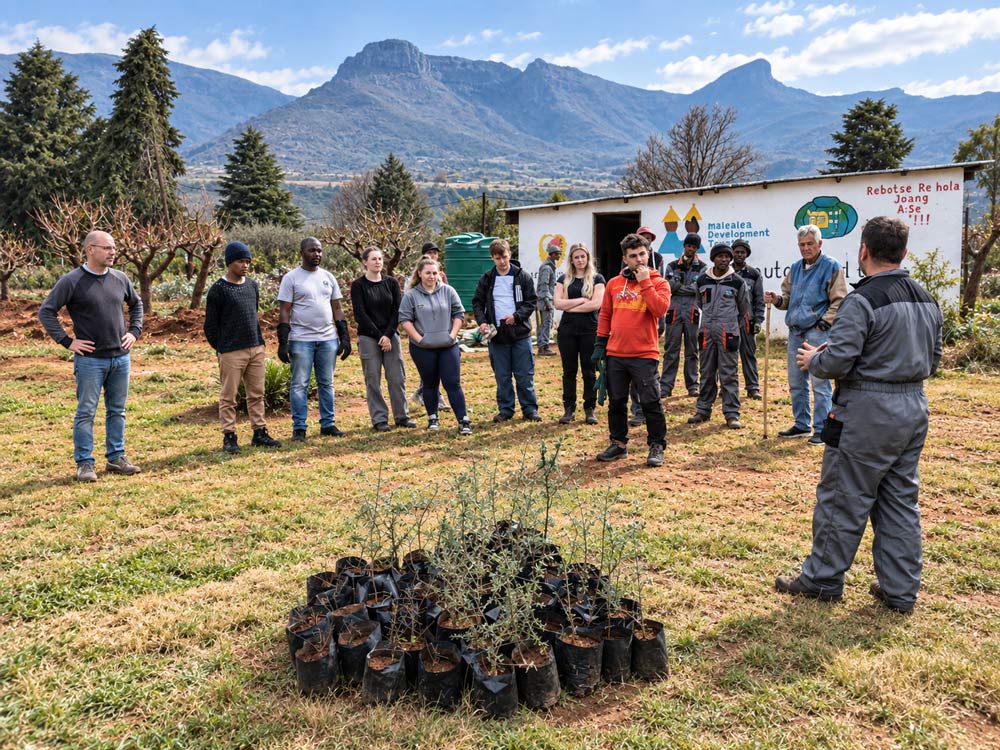
The farm welcomes local schools, farmers and government officials to see sustainable agriculture in action, and to discover ways of farming with nature rather than against it.
Seeing a method working is different from being told about it. A farmer standing beside a swale that has just taken thousands of litres out of a storm, or looking at soil that has had biochar and manure worked into it, can judge for themselves whether it is worth trying on their own land.
Students from Sheffield Hallam University and the National University of Lesotho have worked on the farm too, and Ken Dunn leads tours for visitors — so knowledge moves in several directions at once rather than only outwards from the site.
Together these practices show how sustainable farming can regenerate land, conserve water and build food systems resilient enough to last.
On 30 January 2026, His Majesty King Letsie III of the Kingdom of Lesotho visited the Teaching Farm, where he was warmly welcomed by the community and by many local school children.
Ken Dunn had the honour of showing His Majesty around the farm and sharing the vision of sustainable agriculture, community development and environmental stewardship that the project represents.
For a demonstration farm, that kind of attention matters beyond the day itself. It puts regenerative methods in front of people with the standing to encourage them more widely, and it tells the community around the farm that the work happening on their doorstep is taken seriously.

Most of Lesotho’s rural population are subsistence farmers. Africa’s Gift established the Teaching Farm in the Malealea valley to demonstrate conservation agriculture — so families can get more from the land they already work.
It is also where the wider work connects. Aloe grown here goes into the Eco Cook Bag project, and the soil and water methods shown on these beds are the same ones behind our nutrition work across the valley. The farm is the place those ideas are proven before they are shared.
Running it is unglamorous and continuous. One year’s seed for the farm costs £250.

Every donation funds the soil, water, growing and cooking work in Lesotho, South Africa and Uganda — delivered by volunteers, with the communities that run each project.
A single donation, any amount.
Regular support lets projects plan ahead.
Get in touch to arrange a personal conversation about your wishes.